Welcome to the September 2026 edition of the East Coast Eighth Index, powered by Lit Alerts. Each month, Lit Alerts tracks, analyzes, and reports retail menu pricing across key legal cannabis markets along the Eastern Seaboard. Our goal is to establish a clear, data-driven benchmark for the industry’s most universally recognized and high-volume packaged product: the almighty 3.5g “eighth” of flower.
By observing price movements across our five core state markets—New York, New Jersey, Maryland, Connecticut, and Massachusetts—the index offers brands, operators, and industry analysts an essential window into supply chain dynamics, retail competition, and ongoing price compression.
September 2026 marks an unprecedented milestone in the history of our tracker. As late-summer inventory clears and fall harvest yields begin to impact wholesale channels, regional price erosion has reached a historic fever pitch. For the first time since reporting began, every single state tracked in the index simultaneously hit a brand-new, all-time historic price low.
Here is your comprehensive breakdown of the East Coast flower market for September 2026.
September 2026 Index Summary
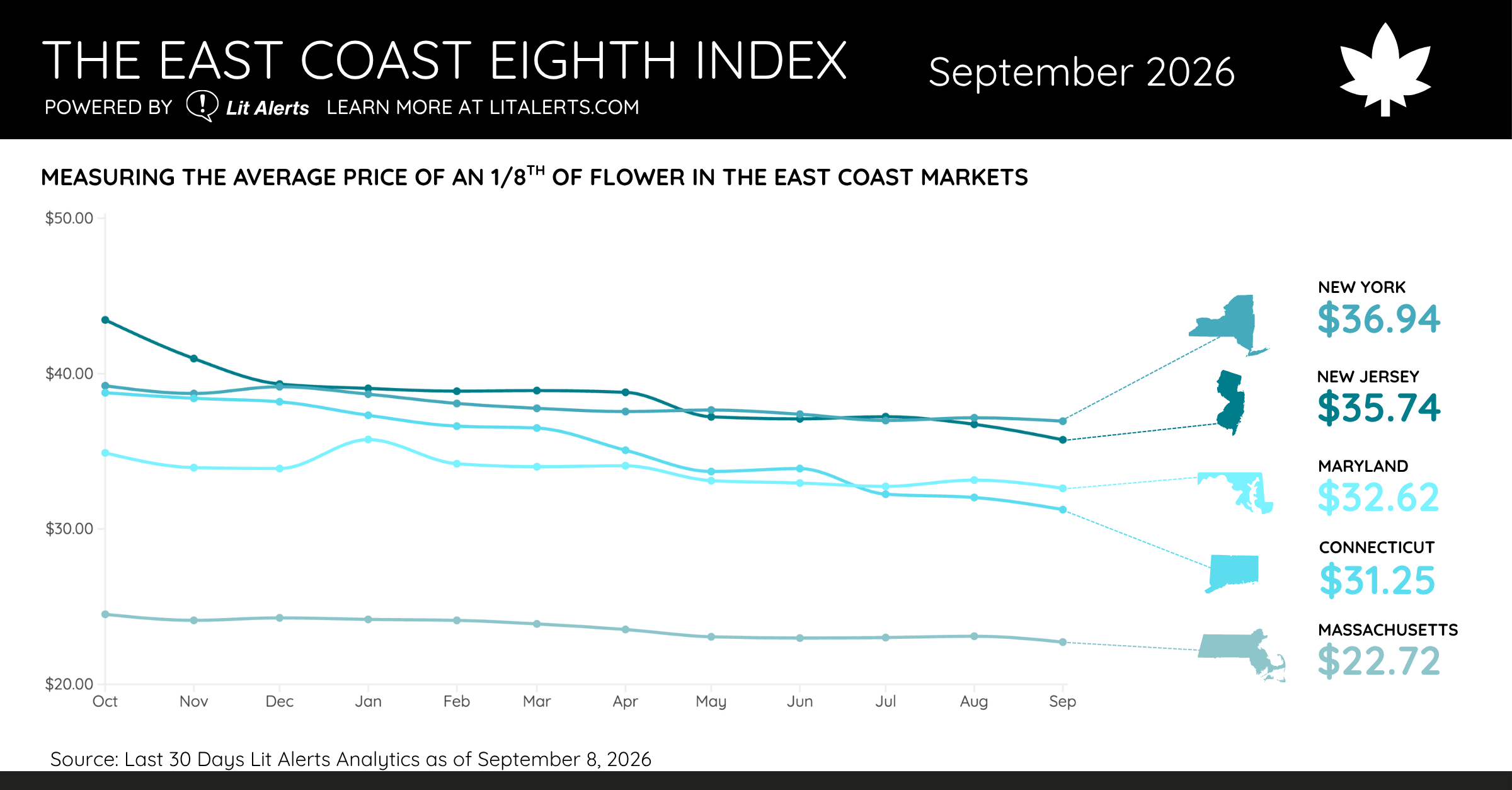
A Full Regional Sweep of Historic Lows: All five tracked markets—New York ($36.94), New Jersey ($35.74), Maryland ($32.62), Connecticut ($31.25), and Massachusetts ($22.72)—established new historical price floors this month.
New York Retains Top Spot & Widens Lead: New York ($36.94) held onto the top spot for the second consecutive month. A steep price drop in New Jersey expanded New York’s pricing premium over its neighbor from $0.42 in August to $1.20 in September.
New Jersey Experiences Sharpest Decline: New Jersey saw the largest single price contraction in the region this month, falling by a full $1.00 (-2.72%) to land at $35.74.
Connecticut Breaks Below $32: Connecticut continued its rapid downward trajectory, shedding $0.78 (-2.44%) to reach $31.25, solidifying its position as the second-cheapest market in the index.
Maryland Resets Its Floor: Maryland reversed its August price bounce, declining by $0.53 (-1.60%) to hit a new low of $32.62.
Massachusetts Pushes Below $23: Massachusetts broke through its previous trading support level, dropping $0.38 (-1.65%) to reach a lean $22.72 per eighth.
Regional Index Average Drops to $31.85: The five-state index average dropped by $0.58 month-over-month, falling from $32.44 in August to $31.85 in September.
An Unprecedented Milestone: All Five States Hit Historic Lows
The headline story of September 2026 is the simultaneous collapse of retail price floors across all five tracked East Coast markets. In prior months, price declines were often staggered—one state would experience a sharp correction while another temporarily rebounded or held flat. September broke that pattern entirely, delivering a uniform, region-wide reset in retail flower pricing.
This synchronized drop reflects broader macroeconomic forces taking hold across the Eastern Seaboard. Cultivation footprints that expanded throughout late 2025 and early 2026 are now producing at peak capacity, creating a steady stream of wholesale supply. At the same time, expanding retail dispensary networks are competing fiercely for consumer market share, relying on promotional pricing and everyday value tiers to drive foot traffic. As a result, price points that were considered deep promotional discounts just six months ago are rapidly becoming the standard retail baseline.
The NY vs. NJ Dynamic: New York Holds the Top Spot as New Jersey Plunges $1.00
The ongoing rivalry between New York and New Jersey for the highest average flower price took a dramatic turn in September.
Throughout the summer, the two tri-state neighbors traded the lead back and forth:
May 2026: New York ($37.66) overtook New Jersey ($37.22) by $0.44.
June 2026: New York ($37.39) maintained a $0.30 lead over New Jersey ($37.09).
July 2026: New Jersey ($37.23) reclaimed a $0.25 lead over New York ($36.98).
August 2026: New York ($37.16) edged ahead of New Jersey ($36.74) by $0.42.
In September, New York ($36.94) maintained the top position for the second month in a row, declining by a modest $0.22 (-0.59%). New Jersey, however, experienced a massive $1.00 drop (-2.72%), tumbling from $36.74 in August to $35.74 in September.
This $1.00 plunge in New Jersey represents the single largest month-over-month drop recorded across all states this month. Consequently, the pricing gap between New York and New Jersey expanded nearly threefold—from $0.42 in August to $1.20 in September. New Jersey’s accelerated decline suggests that operators in the state are aggressively repricing inventory to stay competitive as wholesale market saturation intensifies.
Mid-Tier Pressure: Connecticut Plunges to $31.25 while Maryland Resets
he mid-tier markets of Connecticut and Maryland both reached new historic price floors in September, further narrowing the gap toward the lower-cost end of the spectrum.
Connecticut: Connecticut flower prices dropped another $0.78 (-2.44%) this month, falling from $32.03 in August to an all-time low of $31.25 in September. This extends a continuous price drop that saw Connecticut drop $1.65 in July and another $0.21 in August. Since reaching its peak price of $38.77 in October 2025, Connecticut has seen its average eighth price compress by $7.52 (-19.40%). It now stands firmly established as the second-cheapest market among the five tracked states.
Maryland: Maryland reversed its August price increase ($33.15), dropping $0.53 (-1.60%) to land at a record low of $32.62. After testing higher promotional price points last month, Maryland retailers adjusted back down to align with consumer demand and growing regional price pressure. Maryland has now declined $3.14 (-8.78%) from its peak of $35.76 in January 2026.
Together, Connecticut ($31.25) and Maryland ($32.62) form a tight mid-tier cluster separated by just $1.37, providing consumers with highly accessible pricing points well below the $35 threshold.
Massachusetts Resets the Regional Floor Below $23
Massachusetts has long served as the predictive baseline for market maturity along the East Coast. After spending months trading within a tight $23.00 to $23.10 band, the Bay State officially broke below the $23 mark in September.
Dropping $0.38 (-1.65%) month-over-month, Massachusetts established a brand-new historical floor of $22.72 per eighth. This shift demonstrates that even in a highly mature, fully optimized market, pricing is not entirely static. As neighboring states compress their retail margins, mature operators continue to fine-tune cultivation efficiencies and pricing structures to maintain volume velocity. Massachusetts remains the undisputed budget benchmark for the region, sitting $8.53 below the second-cheapest market (Connecticut) and $14.22 below the highest-priced market (New York).
13-Month Cumulative Long-Term Price Erosion (August 2025 – September 2026)
Examining the full 13-month timeline from peak historical levels in late 2025 to September 2026 illustrates the significant price compression across every market in the index:
New Jersey: -19.61% total drop from peak ($44.46 down to $35.74)
Connecticut: -19.40% total drop from peak ($38.77 down to $31.25)
Maryland: -8.78% total drop from peak ($35.76 down to $32.62)
Massachusetts: -7.34% total drop from peak ($24.52 down to $22.72)
New York: -7.02% total drop from peak ($39.73 down to $36.94)
New Jersey and Connecticut lead the region in overall price compression, both having shed nearly a fifth of their retail value over the past year. Meanwhile, New York and Maryland have experienced more gradual, steady downward trajectories.
Strategic Implications for Brands and Retailers
The unanimous drop to all-time lows across all five markets in September carries clear strategic lessons for cannabis operators:
For Brands: As retail eighth prices compress toward the $30–$35 range in mid-to-high tier states, margin buffer continues to shrink. Brands can no longer rely on state-level market isolation to protect elevated wholesale pricing. Success in this environment requires strict operational cost controls, optimization of cultivation yields, and distinct brand storytelling that gives consumers a compelling reason to purchase above value-tier baselines.
For Retailers: With fall harvest volume entering the supply pipeline, price competition among dispensaries will remain intense. Retailers must closely monitor competitor discounting and manage inventory turnover velocity to prevent holding stock that rapidly depreciates in value. Utilizing menu-level analytics to align procurement with real-time market price shifts is becoming essential for protecting retail gross margins.
It’s important to note that this analysis focuses on the most popular flower package as a proxy for broader pricing trends.
For more pricing info and comprehensive market analytics, schedule a demo or sign up for a 30-day free trial to Lit Alerts today.