When New York’s adult-use cannabis rollout commenced, the state’s retail landscape was defined by scarcity. A bottleneck of licensing delays and legal injunctions meant that during late 2023 and well into 2024, only a modest handful of legal storefronts were operational across the entire state.
In that environment, a conventional wisdom took root among market commentators, brands, and investors alike. As the state’s retail footprint rapidly expands and decentralizes past 500 doors, many assume that early dispensary reliance inevitably leads to declining market rank and revenue.
On its surface, this sounds intuitive. If a brand owes half its register tape to a couple of early doors in Long Island and Lower Manhattan, what happens when hundreds of neighborhood storefronts open across every borough and upstate county? The immediate assumption was that early brand leadership was an optical illusion, an artificial byproduct of line-around-the-block foot traffic at first-mover doors, and that retail decentralization would drag these brands down.
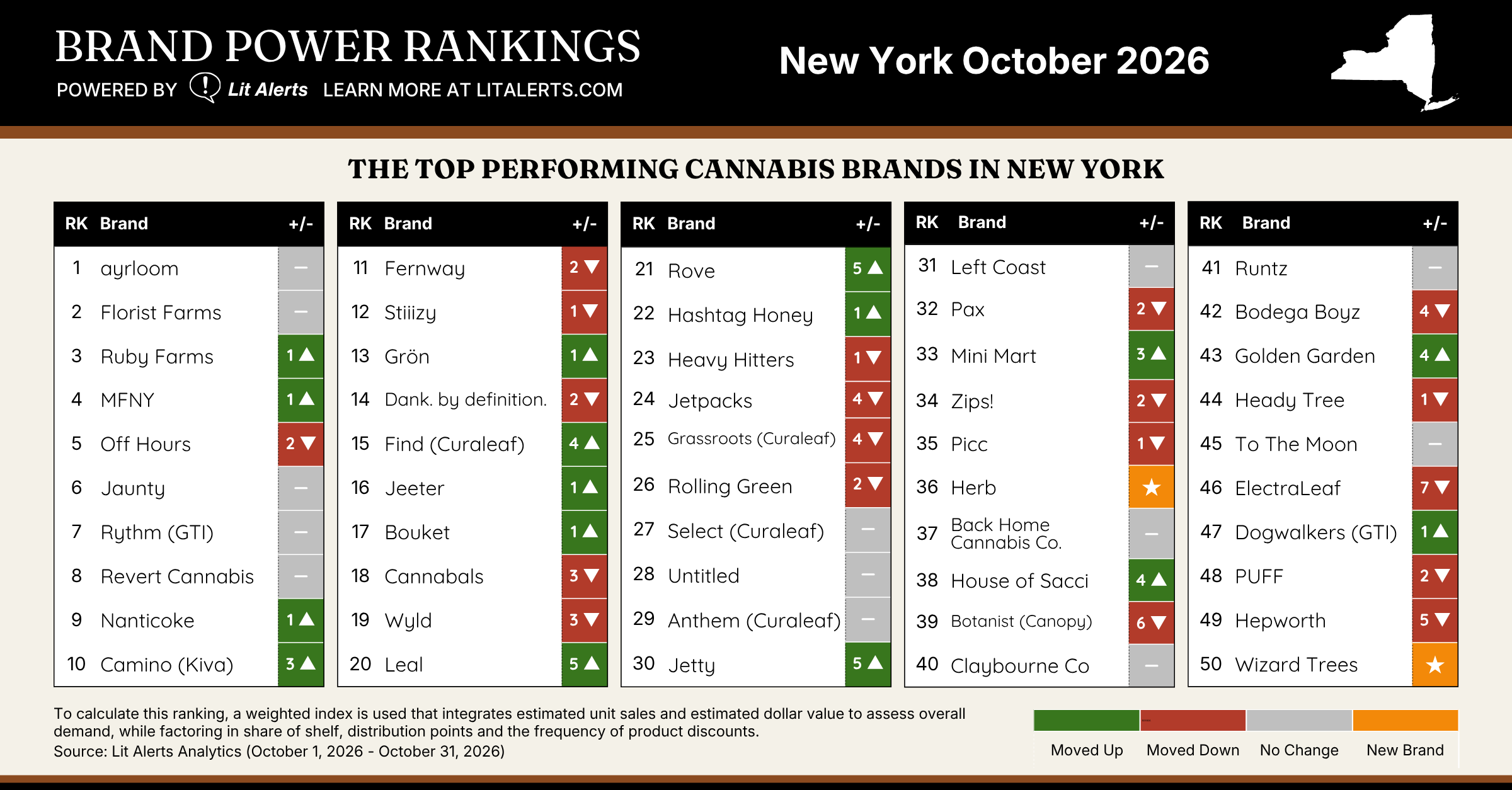
A three-year comparative analysis tracking six of New York’s foundational cannabis brands including ayrloom, Florist Farms, Jaunty, MFNY, Off Hours, and Ruby Farms, across the third quarters of 2024, 2025, and 2026 tests this thesis.
The record shows that while extreme store reliance certainly defined the market’s infancy, the assumption that a revenue and market-share decline was inevitable has thus far been outright refuted. Far from collapsing as retail foot traffic decentralized, early brand leaders converted initial flagship visibility into statewide distribution velocity, turning extreme concentration into sustained top-line dominance.
The Starting Line: When Five Doors Controlled Half the Market
To understand how far the market has traveled, we must first examine the conditions of Q3 2024. At that time, each of the state’s leading brands was carried in roughly 70 to 140 operational dispensaries statewide. Yet consumer purchase patterns told a much narrower story.
In late 2024, brand revenue was not evenly distributed across those active doors; it was pinned to a small cluster of high-volume trailblazers, most notably Strain Stars in Farmingdale, The Travel Agency (in both Downtown Brooklyn and Union Square), Housing Works Cannabis Co. on Broadway, and Happy Days Dispensary in Farmingdale.
Consider the degree of store reliance registered in Q3 2024:
Florist Farms: A staggering 18% of total retail sales value came from a single storefront in Farmingdale. Its top three doors generated 35.0% of total consumer spend, and its top five doors represented 50.1% of brand sales across an 85-door footprint.
Ruby Farms: Displayed an almost identical concentration profile. Its top account represented 16.5% of brand value, its top three accounted for 43.4%, and its top five doors captured 49.7% of statewide retail sales value.
Jaunty & Off Hours: Both exhibited moderate-to-high reliance, with top-five dispensaries commanding 28.2% and 25.8% of total retail value, respectively, and top-ten doors capturing roughly 41% of brand sales.
ayrloom & MFNY: Even the brands with the most expansive footprints in 2024 relied on their top five accounts for more than 21% to 23% of statewide value.
During this period, consumer demand metrics were heavily distorted by pioneer foot traffic. When consumers had few places to shop, high-volume flagship doors dictated which brands moved off shelves. For early brands, surviving meant catering to the replenishment cadences of these early retailers.
Expanding Into 500+ Doors
Between late 2024 and late 2026, the retail supply chain underwent a dramatic transformation. Licensing workflows accelerated, and retail storefronts opened across Western New York, the Finger Lakes, the Capital District, and every New York City borough.
For our cohort of six brands, the number of retail carrying doors exploded:
Ruby Farms: Expanded from 72 carrying doors in Q3 2024 to 389 doors in Q3 2026—a +440% increase in distribution points.
Florist Farms: Scaled its retail footprint from 86 to 451 dispensaries—up +424%.
Off Hours: Grew its active accounts from 125 to 524 dispensaries—up +319%.
Jaunty: Expanded from 115 to 469 doors—up +308%.
ayrloom: Cemented the broadest shelf presence in the state, jumping from 140 to 566 dispensaries—up +304%.
MFNY: Expanded from 118 to 473 doors—up +301%.
As shelf access multiplied fourfold, reliance on early flagship doors evaporated.
By Q3 2026, Florist Farms saw its top-five store concentration drop from 50.1% down to just 7.9%, while its top-ten reliance fell from 63.4% to 13.2%. Ruby Farms experienced a parallel shift: its top-five dependency tumbled from 49.7% to 17.0%. For statewide leaders like ayrloom, the top five accounts represented merely 6.9% of brand sales value by Q3 2026.
Retail foot traffic unmistakably fragmented and decentralized. But what happened to brand revenues and market rank when that reliance dissolved?
Debunking the Automatic Decline
Again the idea was that brands heavily tied to pioneering accounts would experience a revenue and market-share decline as foot traffic spread out.
The market data demonstrates the exact opposite.
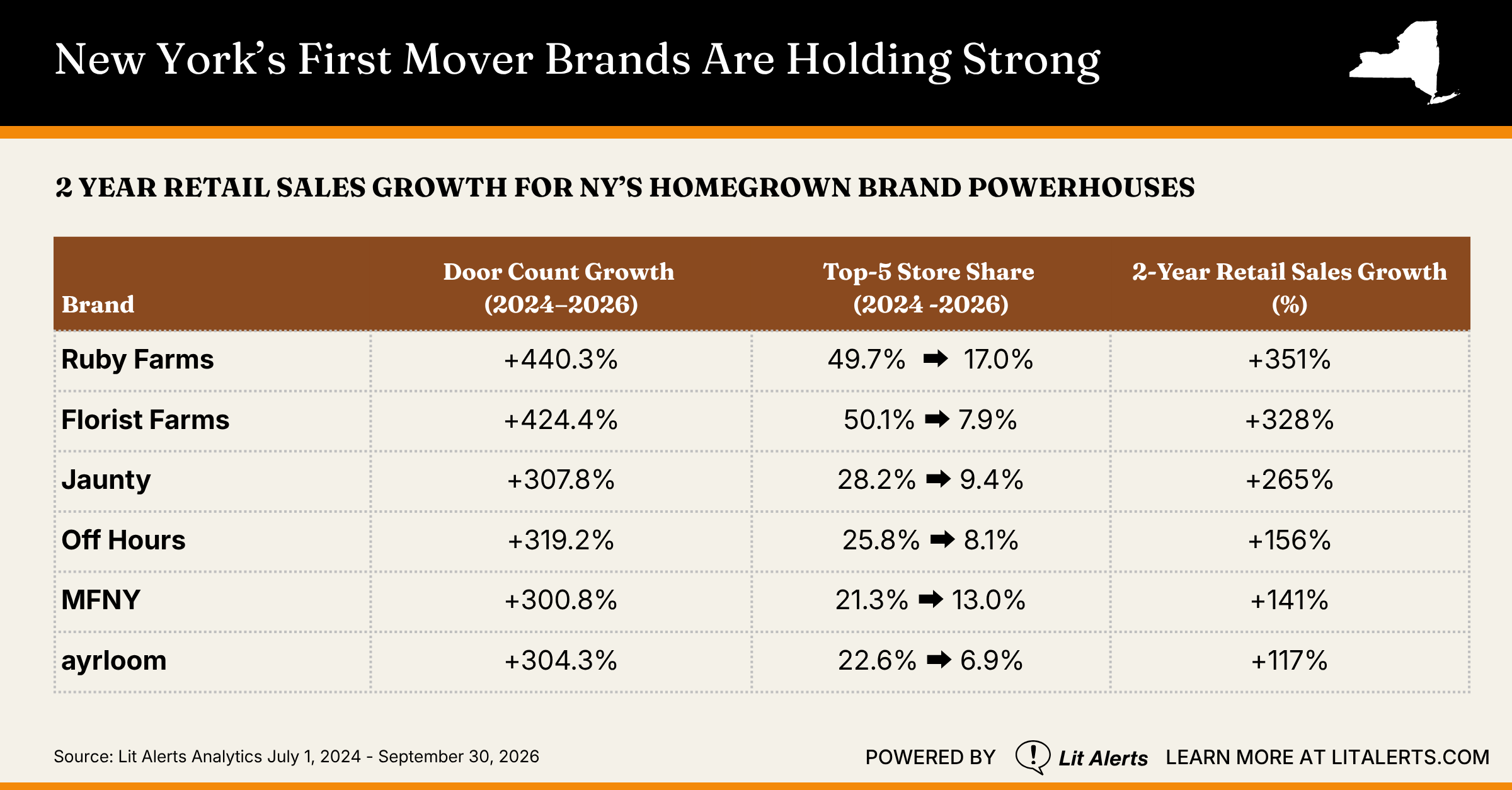
Every single brand tracked across the three-year window generated triple-digit retail sales growth. Across the cohort, estimated total consumer spend expanded by +117% to +351% between Q3 2024 and Q3 2026.
| Brand | Door Count Growth (2024–2026) | Top-5 Value Share (2024 2026) | 2-Year Consumer Spend Growth (%) |
|---|---|---|---|
| Ruby Farms | +440.3% | 49.7% > 17.0% | +351% |
| Florist Farms | +424.4% | 50.1% > 7.9% | +328% |
| Jaunty | +307.8% | 28.2% > 9.4% | +265% |
| Off Hours | +319.2% | 25.8% > 8.1% | +156% |
| MFNY | +300.8% | 21.3% > 13.0% | +141% |
| ayrloom | +304.3% | 22.6% > 6.9% | +117% |
The two brands that suffered from the most acute store reliance in 2024 were the ones that posted the fastest growth in the entire market.
- Ruby Farms, which had nearly half its business anchored to five stores in 2024, surged with a market-leading +350.9% growth rate over two years.
- Florist Farms, tied to a single door for nearly a fifth of its revenue in 2024, posted the second-highest trajectory, growing retail sales by +328.1%.
How could brands so dependent on a tiny handful of locations outpace peers that enjoyed more balanced early distribution?
The answer lies in brand equity transfer. High-traffic early dispensaries served as trial-generating launchpads. When consumers discovered a product line at a flagship counter, they sought out those same SKUs when dispensaries opened in their home neighborhoods.
Far from being a geographic trap, early flagship dominance granted these brands the capital reserves, operational scale, and consumer recognition necessary to secure prime real estate across hundreds of newly licensed dispensary shelves. The sheer volume unlocked by onboarding 300 to 400 new accounts completely overwhelmed the dilution occurring at individual pioneer locations.
What Actually Happened to Pioneer Dispensaries?
A final dimension to explore is the fate of the pioneer dispensaries themselves. Did the flagship doors experience an outright collapse that dragged down their supplier brands?
The estimated retail sales data shows that pioneering accounts experienced two starkly different trajectories depending on their geography:
Long Island Stores Retained Pulling Power
Flagship locations on Long Island did not fold under competitive pressure. For example, Strain Stars in Farmingdale saw total consumer spend across this six-brand cohort increase by +8.4% between Q3 2024 and Q3 2026. While its percentage share of each brand’s total business contracted from ~15%–18% down to 3%–6% due to denominator growth, the absolute register volume running through the door actually grew. Brands did not lose volume at their primary suburban accounts; rather, the rest of the state caught up around them.
Dense Urban Corridors Faced Localized Cannibalization
A different dynamic played out in high-density urban corridors. Housing Works Cannabis Co. on Broadway in Manhattan was one of the first legal adult-use store to open in New York. In Q3 2024, when it had few nearby competitors, it generated outsized sales across all six brands.
By Q3 2026, after dozens of legal dispensaries opened across Lower Manhattan, Brooklyn, and Queens, cohort sales through Housing Works declined by -52.3%. Yet even in this extreme case of retail cannibalization, the loss in sales volume through that single door was tiny compared to the multi-million-dollar consumer gains each brand captured across its broader 400+ store distribution networks.
Conclusion
New York’s three-year transition from acute store bottleneck to open retail expansion provides actionable takeaways for brand operators and capital allocators in evolving regulatory markets:
- Early Concentration Is a Feature, Not a Fatal Flaw: Heavy early reliance on a few high-volume dispensaries is an operational reality of constrained markets. Rather than signaling a weak brand, dominating top doors establishes initial product trial and cash flow.
- First-Mover Footprint Expansion Trumps Per-Door Dilution: When hundreds of doors enter a market, per-store average revenue will naturally compress. Brands that build agile sales, logistics, and account-servicing operations can offset per-door dilution by rapidly capturing new dispensary shelves.
- Pioneer Doors Do Not Dictate Long-Term Rank: Market leadership in a mature market is determined by category execution, supply consistency, and consumer pull, not by whether a brand originated on the shelves of an early flagship account.
The data from New York’s Q3 2024 through Q3 2026 proves that retail decentralization does not penalize pioneering brands. When managed with disciplined field execution, early store reliance serves as the very launchpad that propels statewide market leadership.
Sign up for a free trial today or book a personalized demo to start receiving real-time, actionable market signals for you and your entire team.