The adult-use cannabis market across the East Coast has outgrown single-metric analysis. For more than a year, operators, dispensary buyers, and brand directors relied on the Lit Alerts East Coast Eighth Index as a benchmark for pricing compression. It documented the race to the bottom in Massachusetts, charted the summer pricing duel between New York and New Jersey, and captured historical price floors across Maryland and Connecticut.
However, measuring market health exclusively through a single 3.5-gram jar of flower is like tracking the global automotive sector by monitoring only mid-sized sedans. Dispensary menus have matured into complex, multi-tiered ecosystems. Today, bulk flower formats, infused pre-roll multi-packs, high-capacity all-in-one vaporizers, and precision-dosed nano-beverages generate significant portions of daily dispensary receipts.
We have reached a definitive inflection point. Lit Alerts is officially expanding the East Coast Eighth Index into a comprehensive, multi-category pricing benchmark that tracks every major product category and package size across the region. We are inaugurating this expanded format with our October 2026 New York Retail Price Index, with scheduled expansions rolling out across New Jersey, Massachusetts, and Maryland next month.
Moving Beyond the Eighth: Why the Index Had to Evolve
In our September 2026 East Coast Eighth Index report, we observed late-summer inventory clearance and impending fall harvests driving wholesale margins down, pulling regional eighth pricing down to a collective average of $31.95. In that update, New Jersey dropped sharply to $35.80, Maryland stabilized around $32.38, Massachusetts continued to push lower beneath $23.00, and New York held at $36.94.
While that 3.5g data remains essential, it obscures the operational reality inside retail dispensaries. Single eighths are not the lone revenue driver for flower brands. Bulk flower offerings in 7g, 14g, and 28g formats now account for substantial shelf space as budget-conscious consumers migrate toward volume discounts. At the same time, inhalables have fragmented into distinct sub-categories, from standard 1g distillate carts to premium live rosin disposables and multi-gram concentrates. In the ingestible space, standard 100mg gummy packs face direct margin pressure from single-serve beverages and high-potency tinctures.
This expanded index delivers the visibility required to price inventory competitively, protect gross margins, and identify market anomalies before morning inventory stand-ups.
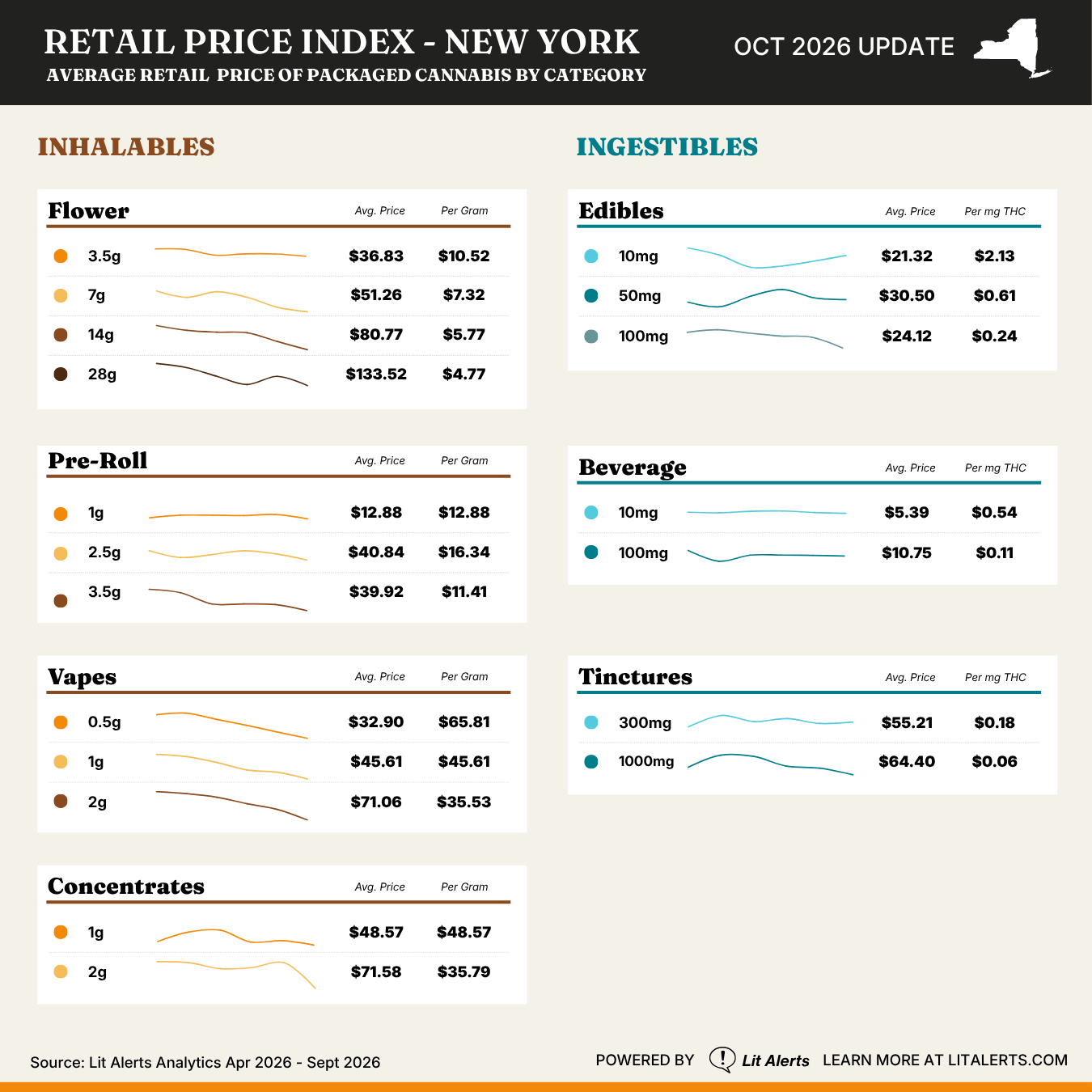
The New York Category Retail Price Index Breakdown
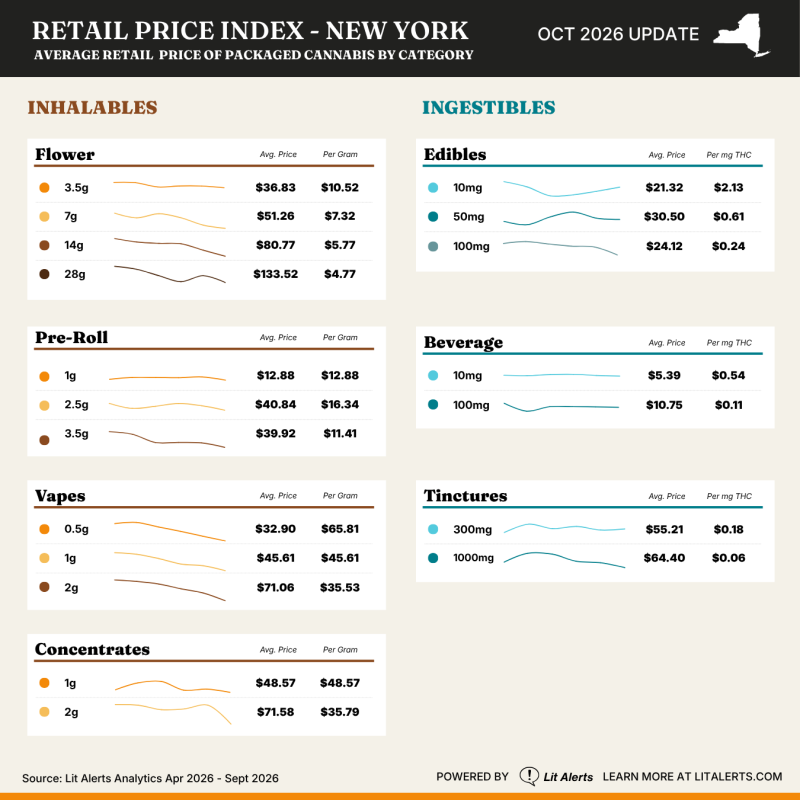
Downward Trends, Anomalies, and Pricing Inversions in New York
Tracking package sizes side-by-side reveals significant behavioral trends across retail shelves that a single eighth index could never uncover.
The Aggressive Volume Curve in Whole Flower
The price-per-gram curve across New York flower formats demonstrates clear volume discounting. Purchasing a 3.5g eighth costs consumers an average of $10.52 per gram ($36.83 total). Moving up to a 7g quarter-ounce brings the unit cost down to $7.32 per gram ($51.26 total), while a 14g half-ounce drops further to $5.77 per gram ($80.77 total).
For consumers buying a full 28g ounce, the average price sits at $133.52, translating to $4.77 per gram. This creates an immediate 54.7% discount per gram compared to purchasing eighths. As canopy yields expanded over the summer, cultivators shifted inventory into half-ounce and full-ounce bags to clear bulk biomass, meeting surging consumer appetite for value formats.
The Pre-Roll Inversion Anomaly
The pre-roll category features the most distinct pricing anomaly in the entire dataset:
2.5g Pre-Roll Package: Average price of $40.84 ($16.34 per gram)
3.5g Pre-Roll Package: Average price of $39.92 ($11.41 per gram)
Under normal retail packaging rules, larger net weights command higher retail prices. In New York, however, a 2.5g package costs $0.92 more than a 3.5g package.
This pricing inversion stems from product formulation. The 2.5g package format is overwhelmingly dominated by high-potency infused multi-packs (such as five-packs of 0.5g joints fortified with liquid diamonds, distillate, and kief). These specialized products command premium pricing from brands like Jeeter. Conversely, 3.5g multi-packs (commonly seven-packs of 0.5g joints) consist almost exclusively of uninfused whole flower or trim, functioning as bulk commodity items. In pre-rolls, processing complexity and perceived potency completely override raw biomass weight.
The Edibles Dosage Disconnect
A similar structural anomaly exists in the edibles aisle:
50mg Edibles: Average price of $30.50 ($0.61 per mg THC)
100mg Edibles: Average price of $24.12 ($0.24 per mg THC)
A consumer purchasing a 50mg edible package pays $6.38 more at retail for half the total THC of a 100mg package. The 100mg package is the standard commercial SKU where major gummy brands compete, resulting in heavy promotional discounting and margin compression. In contrast, the 50mg configuration represents a specialized, low-volume segment populated by ratio-specific formulations, minor cannabinoids (such as CBN and CBG), and artisanal chocolates that do not participate in broader retail price wars.
The Market Anchors: 1g Pre-Rolls and 10mg Beverages
While volatile pricing defined multiple categories, two specific SKUs demonstrated complete price rigidity:
1g Singles: The 1g pre-roll operates as the checkout counter staple of New York dispensaries. In April, the average price was $12.91. Over the following five months, through September’s $12.88 price point, the statewide average moved within a minimal twelve-cent band. It remains an impulse purchase resistant to aggressive price slicing.
10mg Single-Serve Beverages: Low-dose infused beverages held virtually unchanged at $5.39 ($0.54 per mg THC). Driven by disciplined consumer packaged goods distribution strategies from category leaders like ayrloom, ready-to-drink cans maintain retail price parity, avoiding the volatility seen in concentrate and flower categories.
New York Historical Perspectives: The Price Compression Leaders
Examining the six-month raw dataset from April 1, 2026, through September 30, 2026, highlights where margin compression is hitting operators hardest.
The Compression Heavyweights: 2g Concentrates vs. 0.5g Vapes
When assessing which package size is experiencing the highest level of price compression, the data identifies two clear frontrunners depending on how compression is measured:
1. Absolute Dollar Drop and Net Percentage: 2g Concentrates In pure mathematical terms over the six-month window, 2g Concentrates experienced the steepest overall drop:
April 2026: $80.76 average retail price
September 2026: $71.58 average retail price
Net Contraction: -$9.18 per unit (-11.37%)
While 2g concentrates hovered near the $80 mark throughout the spring and mid-summer ($80.42 in August), prices fell sharply by more than eight dollars between August and September. This steep correction reflects a sudden influx of multi-gram cured resin and live resin buckets hitting menus, forcing processors to discount larger jars to maintain wholesale velocity.
2. Consistent, Relentless Erosion: 0.5g Vape Cartridges While 2g concentrates dropped suddenly at the end of summer, 0.5g Vape Cartridges suffered the most persistent, structural price erosion in the state:
April 2026: $36.52 ($73.04 per gram)
May 2026 (Peak): $36.78 ($73.56 per gram)
June 2026: $35.82 ($71.64 per gram)
July 2026: $34.91 ($69.82 per gram)
August 2026: $33.88 ($67.76 per gram)
September 2026: $32.90 ($65.81 per gram)
From its May peak to September, the half-gram vape format lost -10.55% of its retail value (and -9.91% from April). Unlike concentrates, which dropped in a single late-summer movement, 0.5g vapes suffered month-over-month price cuts for five consecutive months.
This sustained decline reveals a format caught in an existential squeeze. Fixed hardware, testing, and packaging costs remain largely identical between half-gram and full-gram cartridges. However, consumer preferences have shifted toward 1g cartridges ($45.61 average) and 2g all-in-one devices ($71.06 average). At $45.61 per gram for a full 1g cart versus $65.81 per gram for a half-gram unit, consumers receive 30% more oil per dollar by sizing up. Monthly half-gram sales volume consistently fell from April to September, forcing dispensaries to continually slash shelf prices to clear aging hardware.
Bulk Flower Acceleration
The data also illustrates how price compression directly correlates with unit volume growth in bulk flower. While standard 3.5g units saw healthy 15.3% unit growth from April to September, larger formats expanded much faster:
7g Units: Grew +25.7% as retail prices fell from $53.39 to $51.26.
14g Units: Expanded +18.2% with pricing dropping nearly five full dollars from $85.73 to $80.77.
28g Units: Rose +17.5% while prices declined from $137.31 down to $133.52.
The Road Ahead for Multi-State Pricing Intelligence
The launch of the New York Category Retail Price Index establishes a comprehensive framework for tracking cannabis retail economics. By capturing price movement across every popular size, package format, and formulation, operators can benchmark their wholesale pricing against real-world retail margins rather than relying on guesswork or anecdotal distributor feedback.
Next month, Lit Alerts will expand this multi-category indexing model into New Jersey, Massachusetts, and Maryland. As interstate operators align regional pricing strategies across state borders, granular category intelligence will separate the brands that preserve gross margins from those that get caught in race-to-the-bottom pricing spirals.
Staying ahead of retail compression requires real-time shelf visibility, automated out-of-stock monitoring, and immediate menu data before your competitors begin their morning sales rounds. You can use the simple tool we’ve built, or build your own tool, but never be the last to know you’re out of stock.
For more pricing info and comprehensive market analytics, schedule a demo or sign up for a 30-day free trial to Lit Alerts today.