Since the initial rollout of the CAURD (Conditional Adult-Use Retail Dispensary) program and the subsequent opening of the general licensing window, industry stakeholders have eagerly watched new retail locations open their doors. For operators, the prevailing narrative has historically been one of wild fluctuations and massive windfalls, a modern green rush where first-movers captured astonishing market share.
But as we close out the summer and move into the final quarter of 2026, the data indicates that the wild era of New York cannabis is officially over. The market is maturing rapidly, and with that maturation comes a brutal, unforgiving stabilization that is completely rewriting the rules of engagement.
We recently pulled the trailing 90-day performance data for New York State cannabis retail locations, culminating in this September 2026 update. To truly understand the current trajectory of the state, we compared this fresh fall data against our earlier benchmark from February 2026.
The days of relying on a localized monopoly are dead. The data shows an evening out of revenue at the top of the market, a tightening squeeze in the middle, and a surprising, slight elevation of the absolute bottom floor. For brands, manufacturers, distributors, and retailers, this structural shift requires an immediate pivot in strategy. You can no longer rely on a handful of mega-stores to drive your entire wholesale business.
Here is our comprehensive breakdown of the September 2026 data, what it says about the changing state of New York retail, and how your business needs to adapt to survive.
Understanding the Data: What is the Great Compression?
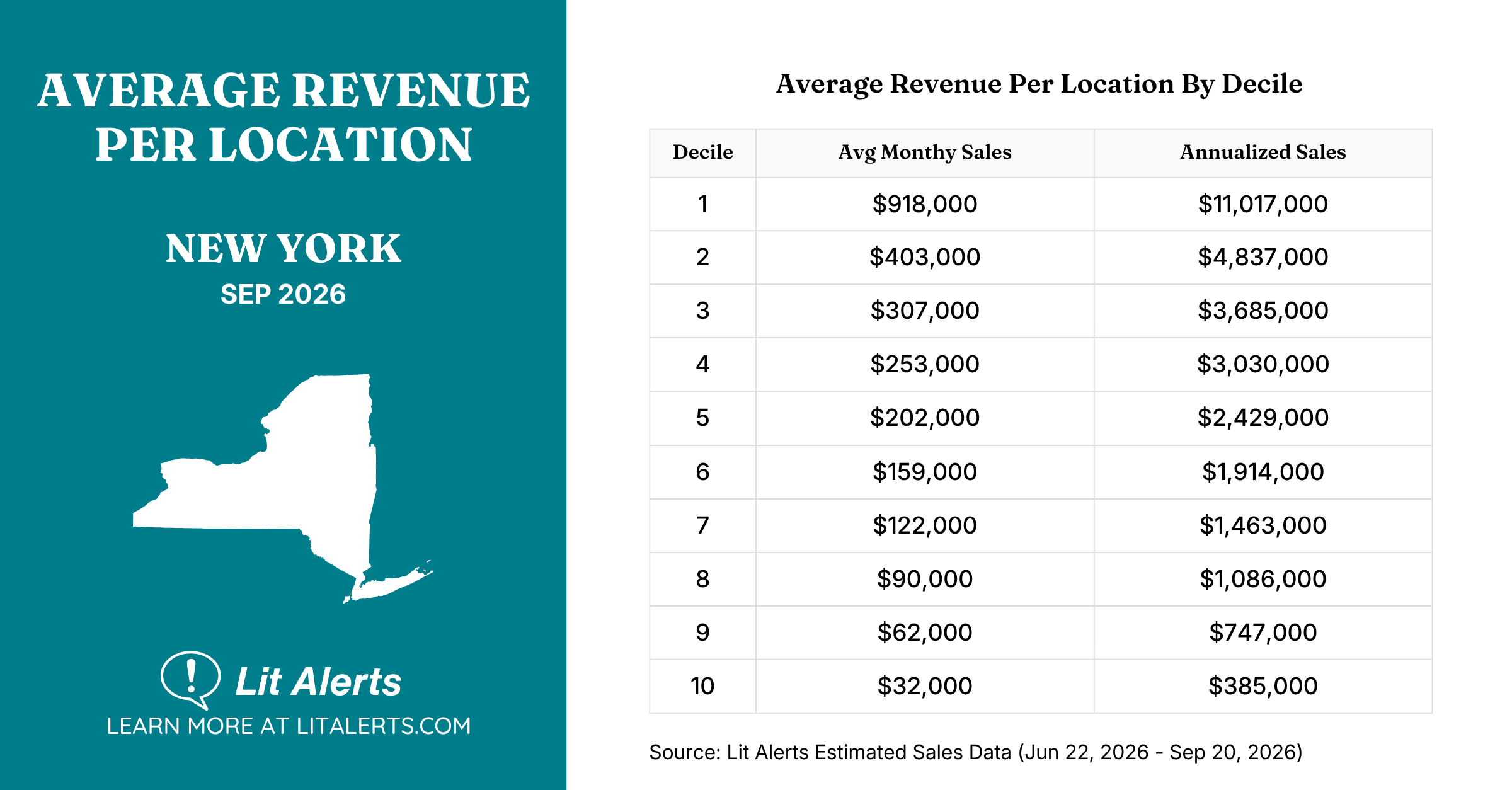
Before diving into the specific tiers, it is crucial to understand what the data is showing us by analyzing New York’s average cannabis retail location average monthly revenue by decile. A decile divides the total pool of tracked dispensary locations into ten equal 10% slices, ranked from the top earners (Decile 1) to the lowest earners (Decile 10).
When we compare the February 2026 data to the new September 2026 data, a glaring trend emerges: the top 80% of the market is seeing their slice of the pie shrink rapidly, while the bottom 20% is actually seeing marginal gains.
This doesn’t necessarily mean the overall state cannabis market is losing consumers. Rather, it means that as more licenses have been activated and new stores have opened their doors, geographic density has increased. Consumers who previously traveled across boroughs or drove forty-five minutes to reach a Decile 1 flagship store now have a Decile 5 or Decile 6 neighborhood store right around the corner. Convenience is winning out over destination shopping, and retail revenue is flattening out across the state as a result.
Let’s break down the realities of this new landscape tier by tier.
The Fall of the Apex Predators: Deciles 1 through 3
Decile 1:
February 2026: $1,768,000 / month ($21.2M annualized)
September 2026: $918,000 / month ($11.0M annualized)
Change: -48%
Decile 2:
February 2026: $694,000 / month ($8.3M annualized)
September 2026: $403,000 / month ($4.8M annualized)
Change: -41%
Decile 3:
February 2026: $505,000 / month ($6.0M annualized)
September 2026: $307,000 / month ($3.6M annualized)
Change: -39%
IMPORTANT NOTE: The top two stores in the state, Happy Days and Strain Stars Farmingdale punch way above this Decile 1 average and remain in a class of their own. However, the rest of the top decile is flattening. Just seven months ago, a top 10% dispensary in New York was pulling in an astronomical $1.76 million per month. Today, that number has been effectively sliced in half to $918,000.
These top-tier locations historically consisted of high-foot-traffic flagships situated in prime Manhattan transit corridors and the powerhouses on Long Island (Happy Days & Strain Stars). They benefited immensely from first-mover advantage and a lack of local competition. However, outside of Long Island, the data shows that this monopoly was entirely artificial and unsustainable.
As the Office of Cannabis Management (OCM) pushed through more license approvals, these stores found themselves surrounded by new, eager competitors. A consumer who once tolerated long lines and high prices at a Decile 1 store has now migrated to a newer, closer option. For the flagship retailers, an $11 million annualized run rate is still a highly successful business, but it requires a radically different operating budget than a $21 million run rate. Those who signed bloated commercial leases based on early 2026 revenue projections are likely facing severe margin calls today.
The Squeezed Middle Class: Deciles 4 through 7
Decile 4: $368k ➔ $253k (-31%)
Decile 5: $269k ➔ $202k (-24%)
Decile 6: $211k ➔ $159k (-24%)
Decile 7: $145k ➔ $122k (-15%)
If you want to understand the reality of running a standard, independent neighborhood dispensary in New York right now, look at Deciles 4 through 7. Ranging from roughly $3 million down to $1.4 million in annualized sales, this represents the operational core of the market. These are the suburban workhorses, the outer-borough staples, and the primary operators in upstate markets.
The middle class of New York cannabis is experiencing aggressive compression. In February, a solid mid-tier store (Decile 5) was doing nearly $270,000 a month. Today, they are barely breaking $200,000.
These stores are currently fighting a brutal two-front war. On one side, the persistent illicit market continues to cannibalize local sales, offering untaxed products at a fraction of the cost without the burden of strict compliance. On the other side, the sheer density of new legal licenses means that neighborhood basket sizes are being split. For an operator in Decile 6 or 7, covering standard commercial rent, labor, security, point-of-sale software fees, and state tax burdens on $122,000 to $159,000 a month leaves virtually no room for error. Operational efficiency is no longer a buzzword for these stores; it is a matter of basic survival.
The Rising Floor: Hope (and Survival) at the Bottom: Deciles 8 through 10
Decile 8: $100k ➔ $90k (-10%)
Decile 9: $57k ➔ $62k (+8%)
Decile 10: $23k ➔ $32k (+39%)
Amidst all the revenue drops at the top of the chart, the most fascinating data points in the September report are found at the absolute bottom. Decile 9 increased from $57,000 to $62,000 per month, and Decile 10 climbed from a dismal $23,000 to $32,000 per month.
How does the bottom of the market grow while the top shrinks so violently? There are two likely drivers for this phenomenon:
Survival of the Fittest: The stores that were truly failing in early 2026 (the ones making $10,000 to $20,000 a month) have simply run out of operating capital and closed their doors. By dropping out of the data set entirely, the mathematical floor of the market is artificially raised.
Market Equilibrium: As top-tier stores lose their monopoly and consumers prefer localized shopping, some of that dispersed revenue trickles all the way down to the bottom tier. Furthermore, struggling stores have been forced to implement aggressive discount strategies and community outreach just to keep their lights on, slightly boosting their baseline foot traffic.
This upward nudge suggests that the market is beginning to establish a true, localized baseline.
What This Means For Cannabis Brands and Manufacturers
In early 2026, a vape manufacturer or edibles brand could hit their state-wide revenue targets simply by securing shelf space in five or six Decile 1 stores. That math no longer works.
Widen the Net: With top-tier store revenues dropping by nearly 50%, brands must transition to a high-volume, wide-distribution strategy. You need to be on the shelves of Decile 4, 5, and 6 stores to make up for the volume lost at the top. This requires a larger sales team, better localized field marketing, and a more robust wholesale CRM.
Re-evaluate SKU Pricing: The middle-tier stores are feeling the margin squeeze. If your wholesale pricing doesn’t allow a Decile 6 retailer to maintain a healthy markup while remaining competitive with the shop down the street, you will be cut from their inventory. Brands need to offer tiered pricing or bulk discounts to help middle-decile retailers survive.
What This Means For Retail Operators
If you are a retail owner looking at this data, you must accept that organic, rising-tide growth has evaporated.
Steal Share Through Experience: To move from Decile 5 to Decile 4 today, you have to convince a customer to stop going to your competitor. You can’t just open your doors and wait for the line to form. You must compete aggressively on customer experience, budtender education, and aesthetic appeal.
Double Down on Retention: Customer acquisition costs (CAC) are climbing as the market saturates. Your focus must shift heavily to lifetime value (LTV). Implement robust, gamified loyalty programs and utilize compliant marketing to ensure your current customers don’t abandon you for the shiny new store opening next month.
Conclusion
The data between our early 2026 benchmark and today’s September 2026 snapshot tells the ultimate story of market maturation. The New York cannabis landscape is transitioning from a localized monopoly into a fiercely competitive, democratized retail battlefield.
The ceiling has lowered drastically, and the floor has nudged up, leaving the vast majority of the market to fight trench warfare in the middle deciles. For the operators, brands, and supply chain partners willing to read the data and adapt, this compression isn’t a disaster, it is an opportunity to out-maneuver slower, top-heavy competitors who are still living in the past. It is time to stop expecting easy wins and start operating with ruthless, data-driven precision.
Sign up for a free trial today or book a personalized demo to start receiving real-time, actionable market signals for you and your entire team.