Earlier this month, Lit Alerts officially expanded their retail pricing index framework in New York, rolling out a multi-category pricing benchmark that tracks every major product category and package size. Today, in anticipation of Cultivated Media’s upcoming Pot Policy Politics show in St. Louis, we are bringing that exact analysisto the Show-Me State with the release of the Missouri Retail Price Index (October 2026 Update).
Missouri represents one of the most mature, disciplined, and profitable adult-use cannabis markets in the entire Midwest. Rather than suffering the erratic price collapses seen in open-license markets, Missouri has established a resilient equilibrium anchored by native medical-era operators, disciplined multi-state operators (MSOs), and brand-loyal consumers.
Analyzing over six months of esimated sales data from April 1, 2026, through September 30, 2026, our expanded index breaks down retail velocity, price shifts, and margin defense across five core categories: Flower, Pre-Rolls, Vapes, Concentrates, and Edibles.
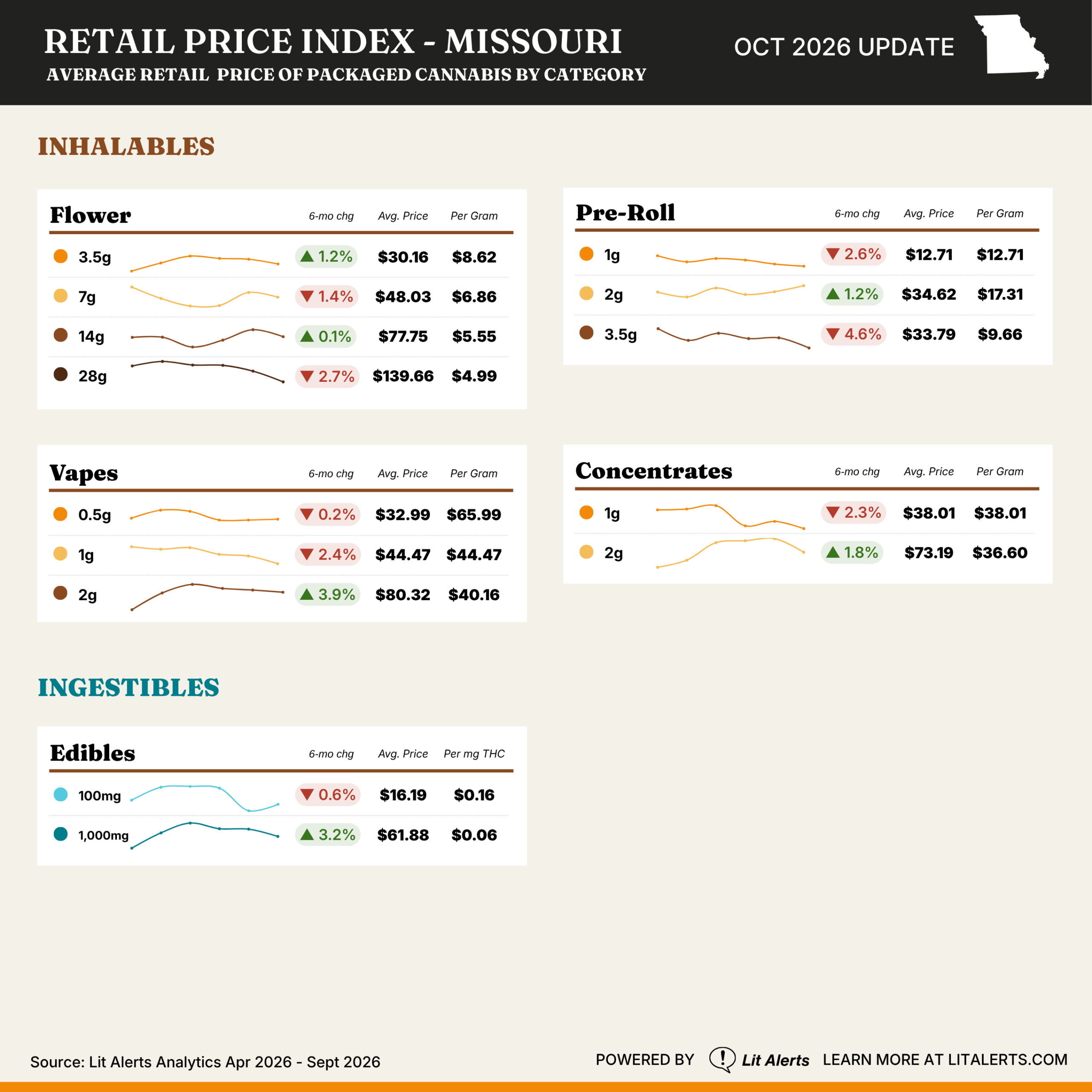
The Missouri Retail Price Index Breakdown
Here is how the numbers stack up across Missouri dispensaries and what the data means for operators navigating the remainder of 2026.
Flower: Stability at the Core, Friction at the Ounce
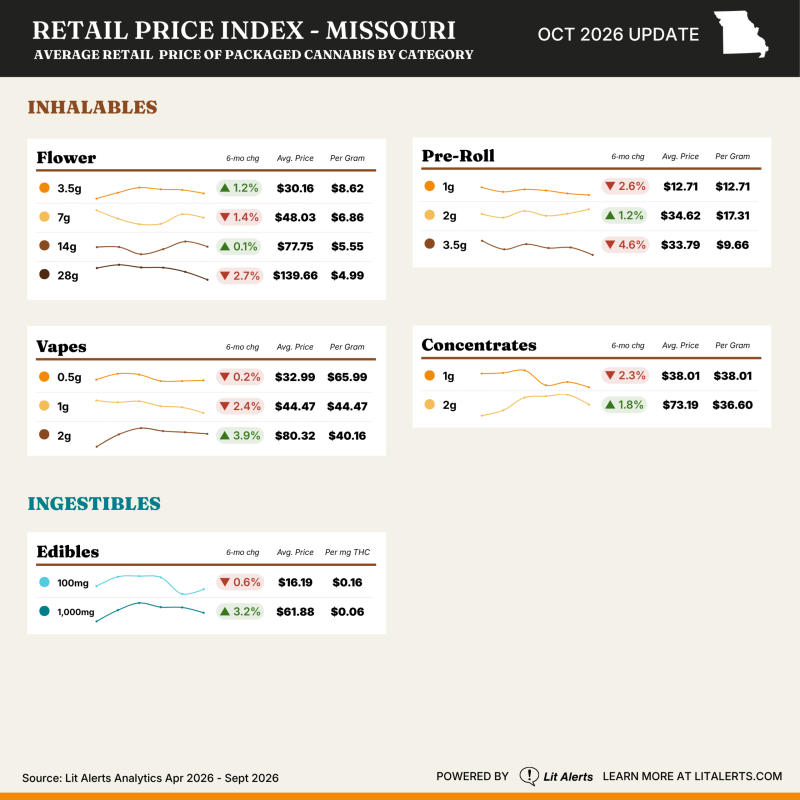
The traditional 3.5g eighth remains the heartbeat of cannabis store foot traffic and revenue. Between April and September 2026, Missouri’s eighth index proved virtually immune to compression, ticking up +1.2% from $29.80 to $30.16 ($8.62 per gram). Monthly volume expanded hand-in-hand with price.
Halves (14g) demonstrated equal resilience, ending the six-month window dead flat at +0.1%, moving from $77.68 to $77.75 ($5.55 per gram).
The real price discovery in raw flower is occurring at the bookends:
Quarter Ounces (7g): Experienced mild compression, dropping -1.4% from $48.69 to $48.03 ($6.86 per gram).
Full Ounces (28g): Suffered the sharpest downward trajectory in flower, sliding -2.7% from $143.48 down to $139.66. Crucially, full ounces crossed below the psychological benchmark of $5.00 per gram to settle at $4.99 per gram.
The Operator Takeaway: Bulk consumers are demanding value, forcing retailers into competitive price-matching on full ounces. However, operators who maintain strong eighth and half-ounce programs continue to capture healthy gross margins without sacrificing volume.
Pre-Rolls: The Value of Infused Differentiation
The pre-roll category continues to be one of the most effective levers for basket building and inventory conversion, but performance hinges heavily on packaging and formulation.
Single 1g pre-rolls saw modest pricing pressure, dropping -2.6% over six months from $13.05 down to $12.71. Despite the slight dip, velocity remains strong in this category.
The starkest trend sits in the divergence between multi-packs and specialized 2g formats:
2g Packages: Gained +1.2% in price, moving from $34.21 up to $34.62. On a per-gram basis, this format commands an eye-popping $17.31 per gram, a 36.2% premium over single pre-rolls ($12.71/g) and more than double the per-gram price of raw eighths ($8.62/g).
3.5g Multi-Packs: Suffered the largest single decline in inhalables, dropping -4.6% from $35.44 down to $33.79 ($9.66 per gram).
The Operator Takeaway: Uninfused multi-packs are sliding into commodity status as budget-minded shoppers look for price breaks. Conversely, 2g premium formats (heavily dominated by concentrate-infused joints and high-potency blunt wraps) give operators an airtight hedge against wholesale flower margin decay. If you are not utilizing biomass for infused pre-rolls, you are handing high-margin basket additions to your competitors.
Vapes: The Rise of the 2g All-in-One Format
Vapes remain the second largest revenue engine in Missouri cannabis, accounting for 28-30% of estimated gross sales in September 2026 alone.
The 1g cartridge is still the workhorse, however, 1g prices slipped -2.4% over six months, softening from $45.57 down to $44.47 ($44.47/g). Half-gram (0.5g) held flat at -0.2% ($33.06 to $32.99), though unit sales continue a slow, secular decline as shoppers favor higher oil capacity.
The category standout is the 2g vape format:
Pricing Surge: Average retail pricing rose +3.9%, climbing from $77.32 in April to $80.32 in September.
Volume Explosion: Units sold rocketed approximately 70% over the last six months.
The Operator Takeaway: While 2g hardware offers a lower per-gram cost to consumers ($40.16/g vs. $44.47/g for 1g carts and $65.99/g for 0.5g carts), the high ticket price ($80.32) significantly expands retail register totals. Consumers want hardware longevity and maximum oil volume, and brands expanding their 2g all-in-one footprint are taking market share directly from single-gram incumbents.
Concentrates: Bulk Dabs Pick Up Steam
Dabbable concentrates exhibited quiet stability across Missouri shelves, though consumer buying patterns mirror what we are seeing in vapes:
1g Jars: Dipped -2.3%, moving from $38.89 down to $38.01. Monthly volume held consistent.
2g Jars: Climbed +1.8%, rising from $71.90 up to $73.19 ($36.60 per gram). Monthly unit volume expanded by +16.7% from April to September.
The Operator Takeaway: High-frequency concentrate consumers are actively looking for 2g jars to streamline repeat purchases. Processors packaging live rosin and cured concentrates into 2g formats are protecting their margins and commanding stronger shelf placement than single-gram offerings.
Edibles: Mass-Market Balance vs. High-Dose Dominance
Missouri’s ingestible market is characterized by remarkable consistency at the entry level and accelerating pricing power at the high-potency end:
Standard 100mg Packages: Remained practically locked in place, shifting down just -0.6% over six months from $16.28 to $16.19 ($0.16 per mg THC). Monthly retail unit velocity held firmly delivering steady monthly revenues.
High-Dose 1,000mg Packages: Climbed +3.2%, increasing from $59.98 in April to $61.88 in September. At $0.06 per mg THC, these high-potency packages provide unmatched economic value for heavy medical and high-tolerance adult-use consumers.
The Operator Takeaway: The 100mg gummy has settled into an established, mass-market consumer habit. The growth vector for ingestibles sits in high-potency formulation. By pricing 1,000mg packages around the $60–$62 mark, brands tap into high-margin consumer segments that value raw milligram efficiency over micro-dosing confectionery.
POT, POLICY, POLITICS: MIDWEST CANNABIS FORUM
Macro Market Signals: What Missouri Means for 2027
Examining the multi-category pricing architecture of Missouri over the past six months reveals three overarching lessons for operators, wholesale teams, and retail merchandisers:
Missouri Avoided the Coastal Margin Cliff: While East Coast markets like New Jersey and Connecticut experienced double-digit percentage drops from their historical peaks throughout late 2025 and 2026, Missouri has sustained disciplined retail pricing bands. Flower prices are anchored around $30 for an eighth, and standard gummies trade tightly around $16. This demonstrates the power of a market governed by seasoned operators who understand how to balance production yields with retail pull.
Form Factor Innovation Shields Margins: Across every category, the data demonstrates that commodity single-units (1g joints, 1g carts, 28g flower) face gentle downward pressure. The products gaining pricing power and velocity are multi-gram, value-added SKUs: 2g vapes (+3.9%), 1,000mg edibles (+3.2%), and 2g concentrates (+1.8%).
The Death of Guesswork Merchandising: Operating a cannabis store or brand using outdated statewide sales averages is a liability. Winning in 2027 requires tracking form-factor-level price elasticity, out-of-stock trends, and true shelf share in real time.
We will be diving deeper into these data points and unpacking what they signal for operators across the Midwest on stage at Pot Policy Politics in St. Louis.
For more pricing info and comprehensive market analytics, schedule a demo or sign up for a 30-day free trial to Lit Alerts today.